|
In this chapter I would like
to elaborate a little on a special rhythm,
much used in reggae, especially Rastafarian
Reggae: The Nyabingi Rhythm. The name for
the rhythm comes from African Congolese
language and in the Rastafarian tradition it
means: "Death to Black and White
Downpressors". The rhythm serves as
music for many Rastafarian chants. Although
the rhythm is used in reggae, it is not a
reggae rhythm in the strict sense of the
word: there are even some Rastafarians,
shunning almost every technology and so on,
who claim that Rasta's can't make reggae and
should stick to Nyabinghi.
There's a lot to say about
Nyabinghi, and on this page you can find a
link to a site that makes special Nyabinghi
drums and give some back ground information
about it. In this section I will stick to
the musical aspect of it, and I would like
to explain some of the basic aspects of it.
But First, I would like to
ask you to listen to the following audioclip
from an original Nyabinghi session.
LISTEN: EXAMPLE0009.MP3
(336 Kb)
As you can hear, the
Nyabinghi rhythm is not a drum rhythm,
played by a drum-set. Although it is used in
Nyabinghi tracks, basically it's a rhythm
played by three different drums, a Bass
Drum, a Repeater or Kete Drum, and the Funde
Drums. The foundation for the Nya rhythm is
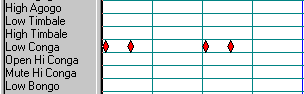
the bass drum. It plays a straight
heart-beat rhythm, which, when you would
have to program it in a sequencer, could
look like this:

While this bass drum plays
the heart beat, the other drums play over
it. The accents of the rhythm are on the 1st
and 3rd count. But it is also possible to
"halve" this, by putting the
accent on the first two counts of a measure.
So on the one and the two. That will make
the rhythm much slower as you will see in
the next chapter.. Below is an audioclip of
a Nyabinghi inspired rhythm I have played on
a handmade conga. It served as introduction
for a track called Jah Glory (SPEED: 150.16
bpm).
LISTEN: EXAMPLE0010.MP3
(329 Kb)
It's very difficult, IF NOT
IMPOSSIBLE, to program the Nyabinghy Rhythm.
It is based on the playing of the three
drums. It's better to record play with a
conga then to program it. But I will, in the
next chapter, show you an example of a
general midi programmed Nyabinghi style
rhythm
|